
-
Member Login
- Home
- About
- Institute Groups
- Membership
- Events
- News & Publications
- Institute Programs
- Resources
- Jobs Board
- Contact Us
- Site Info

ANET 2026 | Breaking the barriers: Innovating to improve ecological outcomes on transport and other linear infrastructure
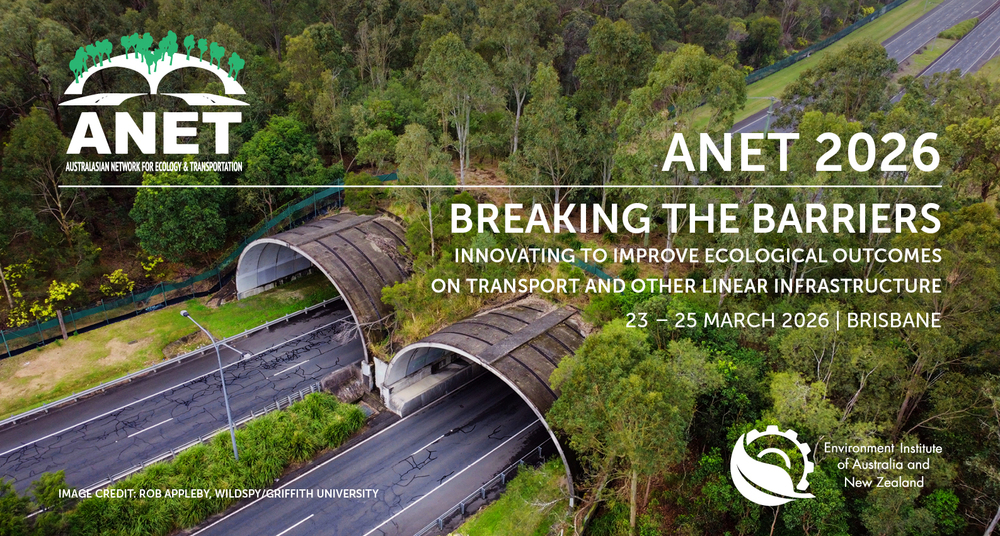
Twenty years after the conference that established Transport Ecology as a recognised discipline in Australasia, ANET returns to Brisbane with a program that reflects how far the field has come – and how much further it needs to go. Join practitioners from across Australia, New Zealand, and the world to hear emerging solutions from leading voices, exchange knowledge, and contribute to shaping the next chapter of transport ecology.
VIEW THE PROGRAM HERE → |
Keynote Speakers
ANET 2026 features two internationally renowned keynotes:
Professor Bill Laurance (James Cook University), Fellow of the Royal Society, Fellow of the Australian Academy of Science, and Australia's top-ranked researcher in ecology, evolution and environment (ranked 6th globally), will share ground-breaking global research on unmapped roads and their implications for infrastructure planning in Australasia.
Professor Lenore Fahrig (Carleton University, joining virtually), Fellow of the Royal Society of Canada and recipient of the Gerhard Herzberg Canada Gold Medal, Canada's top award in Science and Engineering, will challenge the sector to confront the real limits of road mitigation – and what it means for 'nature positive' infrastructure.
Conference themes
ANET 2026 will address the following:
- Projects, landscapes and regions – planning for and delivering ecological outcomes across multiple spatial scales
- Advancing technological solutions – opportunities, challenges and risks
- Implementing best practice – identifying, developing and promoting
- Communication and behaviour-change – translating research and practice into good outcomes across industry, government and society
Who Should Attend
Access global best practice, connect with leading practitioners, and help shape the future of transport ecology in our region. Whether you're involved in the planning, design, construction, operation, or regulation of road, rail, transmission lines, pipelines or other linear infrastructure, ANET 2026 is your opportunity to learn from the world's best and bring practical insights back to your projects and programmes.
What to Expect
ANET 2026 will include plenary and technical presentations, case studies, posters, panels, workshops, trade displays, social networking events and field trips to inspect innovative solutions in South East Queensland.
About ANET
The first road ecology conference in Australasia, entitled 'Breaking the Barriers', was held in Brisbane in 2009. This gathering led to the establishment of the Australasian Network for Ecology and Transportation (ANET) and the development of Transport Ecology as an important scientific discipline in Australia and New Zealand.
ANET has since developed into a formal Community of Practice within the Environment Institute of Australia and New Zealand (EIANZ), promoting best-practice ecological outcomes in transport and other linear infrastructure networks across Oceania and beyond.
Email events@eianz.org to subscribe to ANET Community of Practice updates.
Registrations
The 2026 Australasian Network for Ecology and Transportation (ANET) Conference will be held in the Brisbane Convention and Exhibition Centre on 23-25 March 2026. ANET is the premier event for ecologists, transport planners, regulators, construction and operation professionals, and the local community to engage on the interactions between transportation and ecology. The conference will include two days of technical presentations, posters, panels, workshops and trade displays, a one-day field trip and a networking social event. Registration includes access to all sessions.
Registrations are closing soon! - Secure your place today
Tickets are strictly non-transferable and are not to be shared amongst people on separate days. If you wish to attend only one day of the conference please contact events@eianz.org and we can offer options for your attendance.
Conference fees
| EIANZ member* | $990 |
| EIANZ Student member* | $365 |
| Non-members* | $1285 |
*This is an all inclusive registration fee charged in AUD including GST. Registrations are via credit card.
For wildlife carers who wish to attend the conference please contact events@eianz.org for a discounted conference rate.
We have secured a discounted accommodation rate for the Rydges South Brisbane, next door to the convention centre. Details of how to access rate will be sent in your registration confirmation email.
REGISTER HERE → |
To register a group or another person please use the blue button at the bottom of the page.
Not an EIANZ member?
Consider joining as a student, associate or full member today! To receive the member rate to the conference make sure you apply for membership prior to registering for the event! Join here →
Sponsorship Opportunities
ANET is the premier event for ecologists, transport planners, regulators, construction and operation professionals, and the local community to engage on the interactions between transportation and ecology. There are many benefits to sponsors for ANET2026. Benefits include:
- Demonstrates commitment to best practice environmental outcomes.
- Demonstrates commitment to young environmental professionals and their career development.
- Direct access to a captive audience of your potential future customers and /or workforce.
- Exposure to local, national, and potentially international delegates.
- Opportunity for broad exposure to delegates
VIEW THE SPONSORSHIP PROSPECTUS → |
ANET 2026 is proudly sponsored by
| Gold Sponsor | ||||
| Silver Sponsor | ||||
 |
 |
|||
| Bronze Sponsor | ||||
 |
||||
| Trade display sponsors | ||||
 |
 |
 |
||
 |
.png) |
|||
 |
 |
 |
||
 |
 |
 |
||
Event details
When: 23-25 March 2026
Where:
Brisbane Convention and Exhibition Centre
Merivale St, South Brisbane, QLD
Cost: $990 EIANZ members, $365 EIANZ student members, $1285 Non-members (AUD Inc GST))
Contact: EIANZ - events@eianz.org or +61 3 8593 4142
Register now and secure your attendance
Event date has passed
We acknowledge and value the rights and interests of Indigenous Peoples in the protection and management of environmental values through their involvement in decisions and processes, and the application of traditional Indigenous knowledge.